Baseline without additive
Record fuel, useful heat, load, emissions and combustion residues.
OWO / INDUSTRIAL ENERGY
Combustion optimisation. Potential measured in practice.
A presentation for industrial partners. A mineral–carbon additive for combustion processes: from a technical hypothesis and historical observations to a controlled pilot at your facility.
Request a pilot assessment
English presentation slides translated from the supplied Croatian materials. Read each slide together with the accompanying text and evidence limitations. They do not provide independent verification or performance guarantees.

02 / Product
The supplied presentation describes EcoTherm CarbonX™ (ETCX) as a mineral–carbon additive intended to optimise industrial combustion, with particular interest in lower-quality coal. The presentation uses the designations ETCX, GIS-1 and GIS-2. Historical data for these names do not establish equivalence to the current formulation; composition and batch traceability are required.

03 / Composition
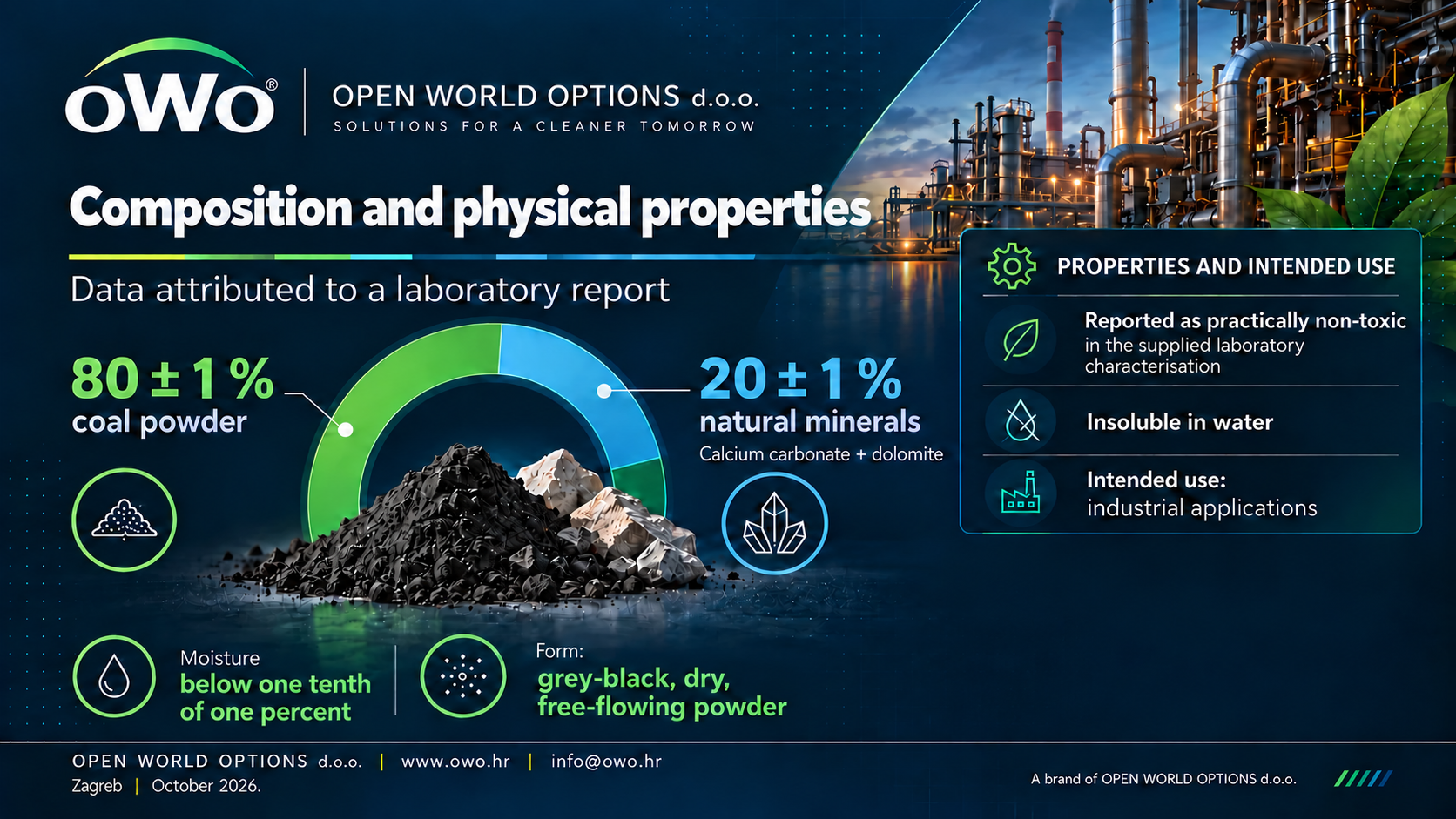
According to the presentation: 80 ± 1% coal powder, 20 ± 1% natural minerals (calcium carbonate and dolomite), moisture < 0.1%, and a grey-black, dry, free-flowing powder; insolubility in water is also stated. These are data attributed to a laboratory report in the presentation, rather than an independently verified specification of the current batch. Obtain a composition report, particle-size data and a quality certificate before use.
04 / Mechanism
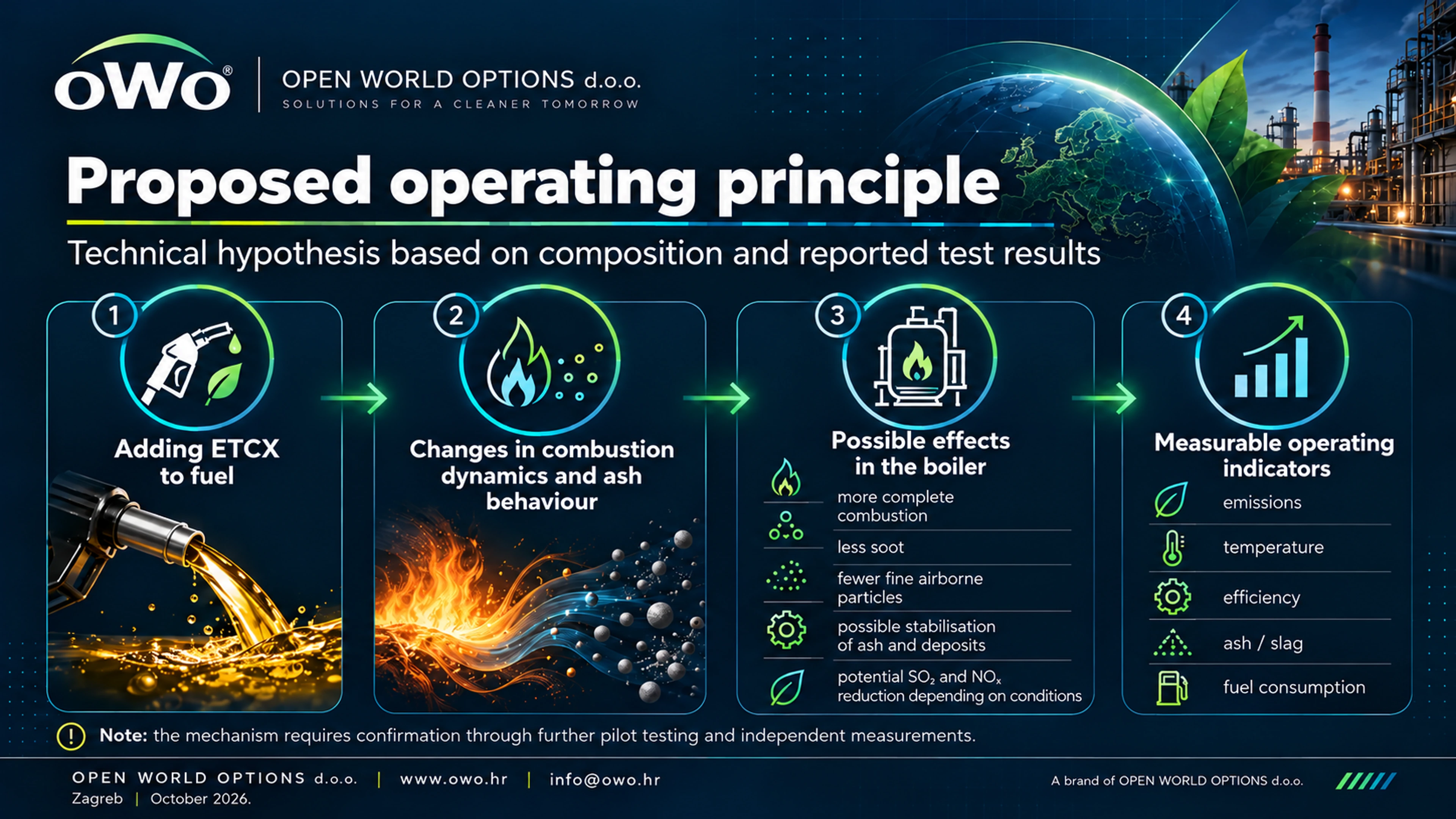
The technical hypothesis describes adding the additive to fuel, changes in combustion dynamics and ash behaviour, and possible effects on boiler operation. Measure useful heat, specific fuel consumption, emissions, ash and deposits. The presentation does not validate the mechanism or prove causation; comparable measurements without and with the additive are required.
05 / Dosing
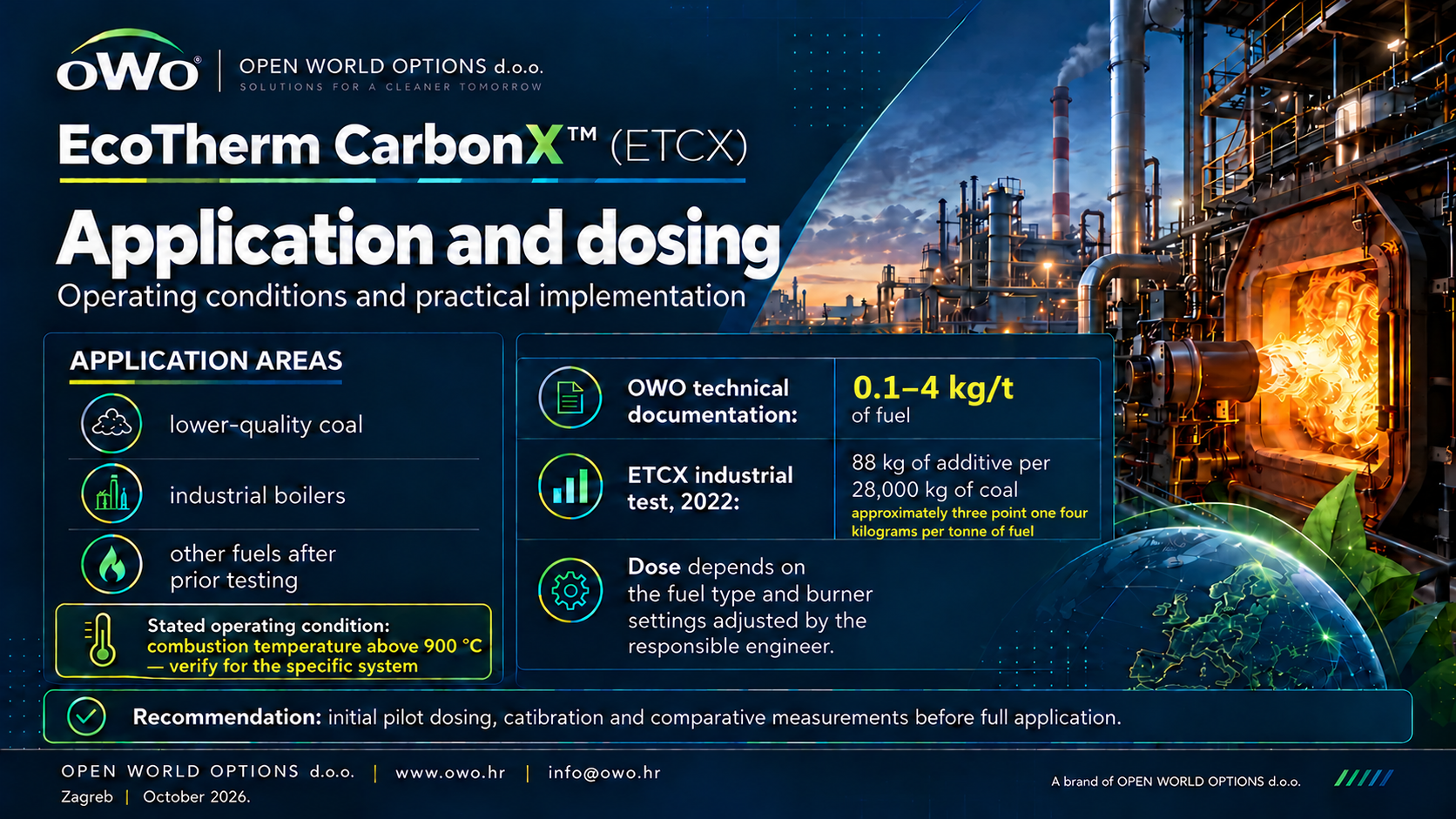
The presentation states an indicative range of 0.1–4 kg of additive per tonne of fuel, depending on the fuel type and burner settings adjusted by the responsible engineer. For the historical ETCX test it lists 88 kg per 28,000 kg of coal, approximately 3.14 kg/t. These are not universal operating instructions. The stated temperature above 900 °C requires technical assessment for the particular system. Agree the dose and injection point with the responsible engineer, with feeder calibration and a risk assessment.
06 / Results
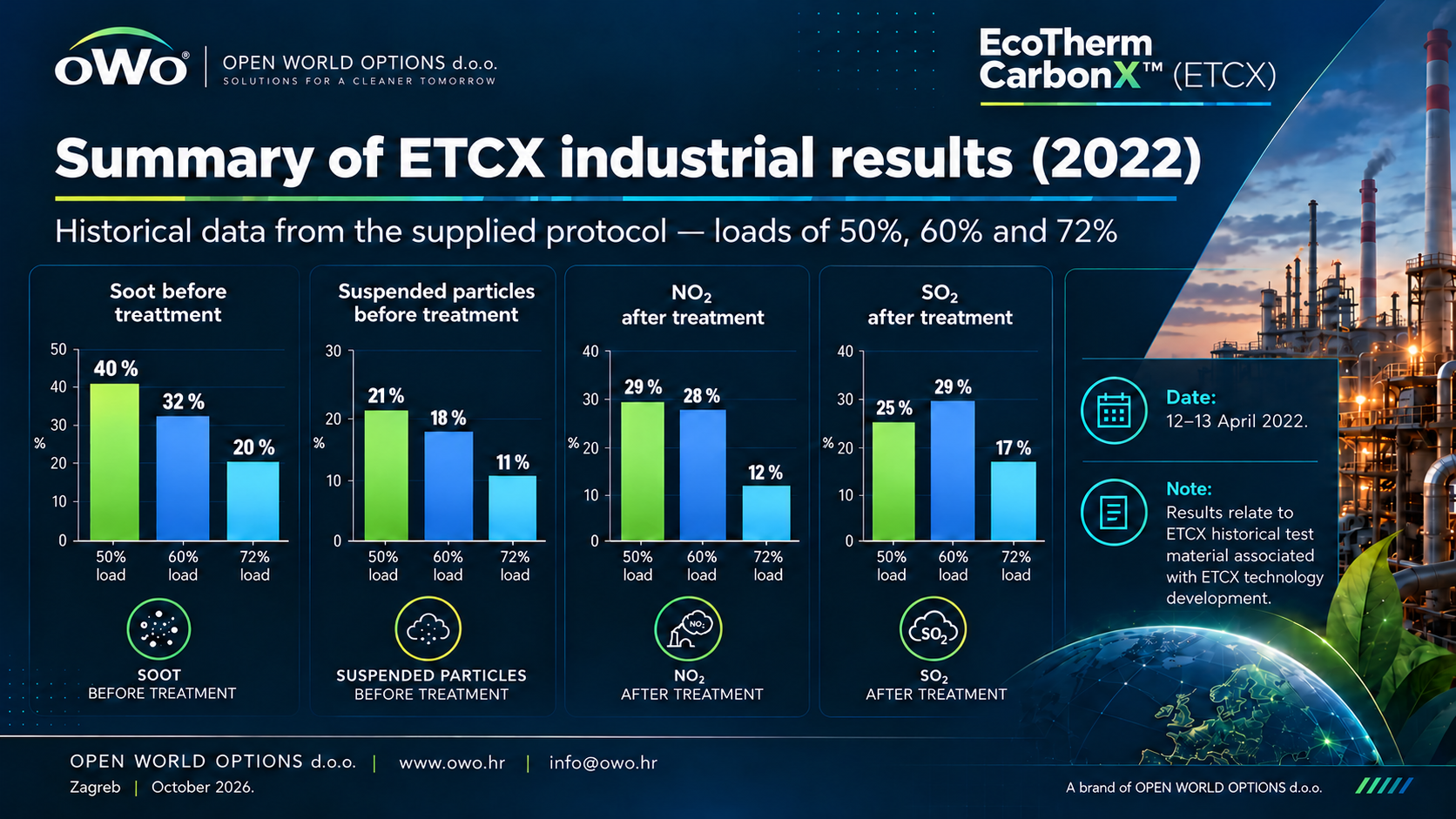
The presentation shows historical test data from 12–13 April 2022, at loads of 50%, 60% and 72%. The table reproduces percentages shown on the slide; the slide alone does not establish the percentage definition, reference baseline, measurement uncertainty or traceability to the current product. These data do not guarantee emission reductions or establish regulatory compliance.
| Indicator / measurement point | 50% load | 60% load | 72% load |
|---|---|---|---|
| Soot before treatment | 40 % | 32 % | 20 % |
| Suspended particles before treatment | 21 % | 18 % | 11 % |
| NO₂ after treatment | 29 % | 28 % | 12 % |
| SO₂ after treatment | 25 % | 29 % | 17 % |
This experiment is separate from the 2022 ETCX industrial test. Values from the previous page are retained separately; the original report is not included in this ZIP archive.
The report “Test raport EN” compares two runs on a modular boiler with a nominal thermal capacity of approximately 1 MW. Both runs used 12.5 kg of coal and an initial water volume of 325 litres.
Test duration: 3 h 20 min without additive and 5 h 30 min with additive. Initial water temperatures were approximately 3.5 °C and 4.0 °C respectively. The stated efficiency comes from the report's heat-balance calculation.
The emission units mg/Nm³/Gcal are reproduced from the report without reinterpretation. The values shown are not a direct comparison with emission limits. Percentage changes were calculated from the approximate values in the report.
These are the results of the described runs, not a universal performance guarantee. The supplied report does not state the test date or location, the identity of the tester, the additive dose, the number of repetitions or measurement uncertainty. Assessment for industrial application requires verification in a controlled pilot.
Source: “Test raport EN.pdf”, sections 4–7, pages 2–3. The report specifies coal with a calorific value of approximately 4,500 kcal/kg, moisture of 15–16% and ash content of approximately 17%. It provides no numerical results for CO₂, PM10, PM2.5 or benzo(a)pyrene. These runs do not establish guaranteed fuel savings, an increase in continuous power output or regulatory compliance.
07 / Safety
Obtain a current safety data sheet before handling and confirm classification for the actual mixture. Presentation claims of non-toxicity or non-flammability do not replace verification. Assess dust, inhalation exposure, powder flammability and explosibility, storage and equipment compatibility. Determine eye, skin and respiratory protection from the risk assessment and facility documentation.
08 / Pilot protocol
Approximately 30 days, with a facility-specific protocol. Agree responsibilities, comparable loads, fuel characteristics, measurement methods, success criteria and stop criteria before starting. OWO coordinates technical and commercial communication; the responsible facility operator approves use.
Record fuel, useful heat, load, emissions and combustion residues.
Document the batch, dose, injection method and every change in operating conditions.
Compare specific consumption and normalised emissions for similar fuel and load; define measurement points before and after treatment.
Report uncertainty, additive cost and operational effects; base the decision on data.
For an initial assessment, send the fuel type, thermal capacity, operating conditions and measurement objectives.
Request a pilot assessment info@owo.hr